Install Shoutcast Server Centos 6
I was asked to build a shoutcast server on a linux centOs 6.6 server. It’s not that hard to set up a shoutcast stream: Fire up your linux server and add a new shoutcast user: adduser shoutcast passwd shoutcast now sign in using this new account. Su - shoutcast. Create a new directory. Mkdir shoutcast. And go there. Cd shoutcast. Server on Centos (linux) Shoutcast Technical Support The free customizable Winamp media player that plays mp3 + other audio files, syncs your iPod, subscribes to Podcasts and more.
- Shoutcast Tv Server
- Install Shoutcast Server Centos 6 0
- Install Shoutcast Server Centos 6
- Centos 7 Server
- Install Shoutcast Server Centos 6.9
- Centos 6 Install Ftp Server
- Shoutcast Server Software
- Select the type of storage for installing CentOS. If you install CentOS 6 to local Hard Drive, Select [Basic Storage Devices]. If you install to the storage that is connected in storage area networks or mainframe, Select the bottom. [7] Click [Yes, discard any data] to proceed if it's no ploblem to remove any data on the Hard Drive.
- This tutorial explains how to install icecast kh10 server on centos 6 server # cd /usr/src # wget # tar -zxf icecast-2.4.0-kh1.tar.gz # cd icecast-kh-icecast-2 IceCast Hosting Shoutcast Hosting.
- Is there any documentation on the difference between a Minimum install and either the Web Server or Database Server install options? I am setting up a virtual system with four CentOS systems. One will be a minimal system, one will be a Database back-end, and two will be Web Servers. ↳ CentOS 6 - Security Support; CentOS Legacy Versions.
- Portbase: Specify the port which clients and sources need to use to connect to the server [Default = 8000] SHOUTcast 1 sources are only able to connect to 'portbase + 1'. Autodumpsourcetime: Specify how long before an idle source is dumped from the server (in seconds) [Default: 30] A value of zero means there is no timeout of an idle source.
- Apr 22, 2015 Installing Shoutcast on CentOs – shoutcast version 1 and 2 April 22, 2015. I was asked to build a shoutcast server on a linux centOs 6.6 server. It’s not that hard to set up a shoutcast stream: Fire up your linux server and add a new shoutcast user: adduser shoutcast passwd shoutcast now sign in using this new account.
cPanel is one of the most popular commercial control panel for Linux web hosting, I have been working with cPanel for last 3+ years to manage all Shared, Reseller and business hosting customers.
It comes with cPanel and Web Host Manager, which makes web hosting easier for you. WHM provides you root level access to your server whereas cPanel provides user level access interface to manage their own web hosting account on the server.
Features of cPanel
cPanel control panel is very versatile control panel for managing your hosting servers, It has lots of features which make Web hosting easier for you. Some of them are listed below:
- Powerful GUI controls on your server with WHM.
- Can perform tedious tasks like Backups, Migrations and restorations in a very easy and smooth manner.
- Excellent DNS and mail server management for main server and as well as client account.
- Can easily switch/enable/disable services for server.
- Can configure SSL/TLS for all server services and client domains.
- Easy integration with Phpmyadmin to provide a web based interface to manage your MySQL databases.
- Feel free to Rebrand it.
- Can be easily integrated with WHMCS to automate billing management.
Here In this article, We’ll be covering cPanel & WHM installation on CentOS/RHEL 6.5 and share some more useful information which will help you to manage cPanel & WHM.
Installation Prerequisites
- A fresh and minimal installation of CentOS 6.5 server.
- A minimum of 1 GB.
- A Minimum of 20GB free disk space required for cPanel installation.
- A cPanel license.
Installation of cPanel in CentOS and RHEL 6
First insure that OS version on which your Linux box is running, to do so, please use following command.
If you don’t have the latest version, please update your OS to its latest version, In CentOS and RHEL, we can simply do it with yum package installer.
Once updates completes, and then check the latest OS version with same above command.
Next, ensure that your system has a standard hostname, otherwise set it as follows.
Once you’ve ensured the OS version and hostname, you don’t have to install any other dependency packagees, cPanel auto installer script does all for you. We can download cPanel installer file under /home directory.
This above command changes your session to the home directory, downloads the most recent version of cPanel & WHM, and runs the installation script.
Important: I strongly recommended to run cPanel auto installer script in screen mode if you are doing it with SSH because it takes 30-40 minutes to complete the installation depending on your server resources and bandwidth speed.
Sample Output
Now, you need to wait for the cPanel installer script to complete its installation.
What Auto Installer Script Does for You
cPanel heavily modifies your operating system and that is the reason that no cPanel Uninstaller available on the web so far, you need to reformat your server to remove cPanel completely from your server.
- It checks for various packages to ensure that there will be no conflicts and it finds any package conflict, it uninstalls previous packages with yum and that’s why its recommended to install cPanel on a Fresh OS.
- Downloads language and base files for installation.
- Installs various Perl modules through CPAN and other required packages with yum.
- Downloads and compiles PHP and Apache with various associated modules.
Once that script completes its installation, it will shows up that cPanel installation is complete. You may be asked to reboot the server after installation.
After that you need to complete the installation wizard from its web based interface and you can access WHM with the following URL.
cPanel will open up its web interface like similar to below.
Please login with user “root” and your password. There are some more clicks remaining to complete the cPanel installation. Agree End User License Agreement by clicking “I Agree?/Go to Step 2” button:
cPanel WHM Agreement
Please do provide the working email address and contact SMS address in the column of “Server Contact Email Address” and “Server contact SMS address” respectively because your cPanel sends all important alerts, notification to this EMail-id (Recommended). You can fill the rest details as well, if you have one.
Please provide a valid FQDN hostname and Resolver entries for your server in this Networking section, you can use Google resolvers in this section if you don’t have your ISP’s resolvers. Please see the image below.
cPanel WHM Hostname Setup
If you have more than one IP attached with your NIC card and you want to set up a specific IP for your Server’s main IP, you can do that from here, to do so please choose the IP from the drop down and click on “Go to Setup 4”.
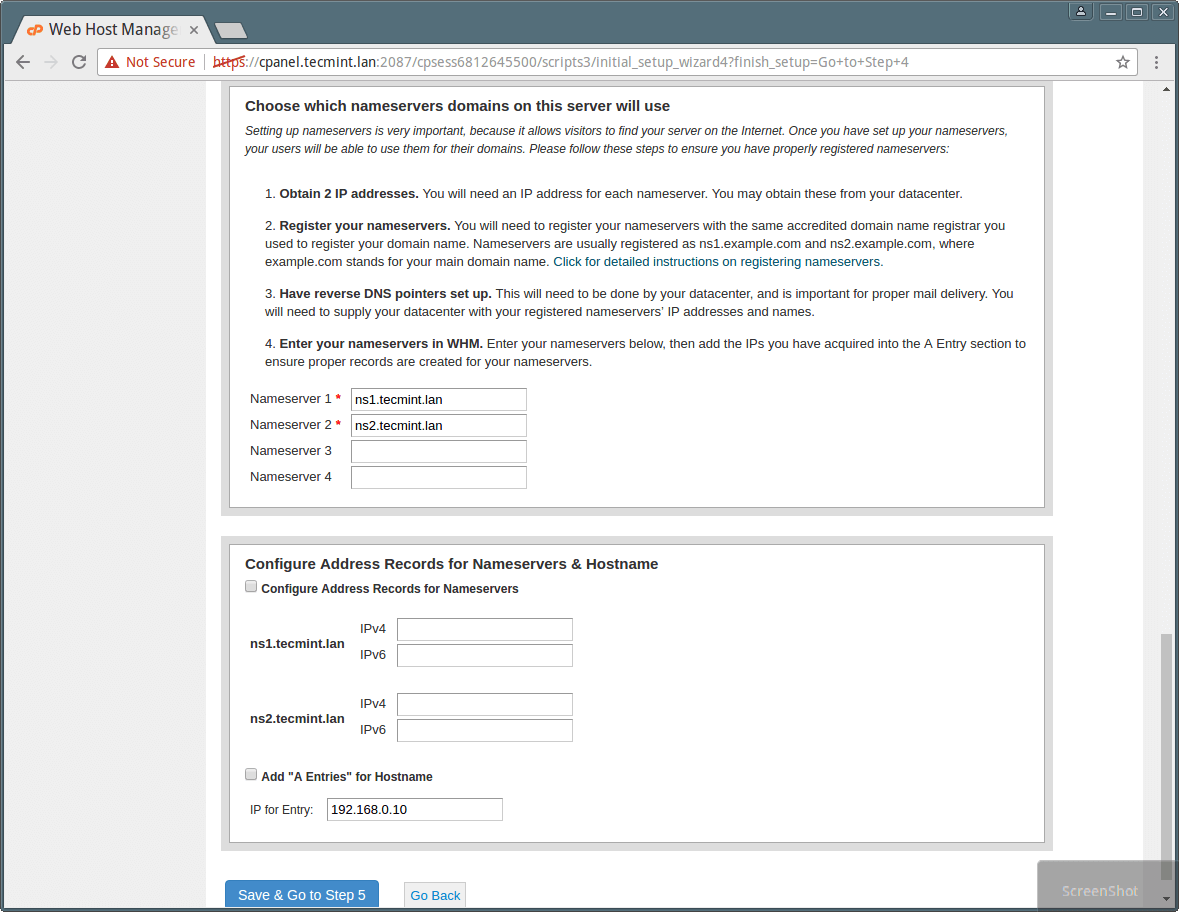
In the 4th setup wizard, you can select DNS server which you want to use. You can choose one of them according to their Advantages, disadvantages and your server resources. Please read the comparison carefully and select the DNS server. Please see the image below.
cPanel WHM Setup Name Servers
In the same step, please write down Name Servers you want to use in format of ns1/ns2.example.com. Also, Add an A entry for your hostname and nameserver by selecting the check box, please see the image below.
You can select and set up different services like FTP, Mail and Cphulk in the Step 5 of this web based wizard, please see the snapshots and description below.
You can select FTP server of your choice from this wizard, which you want to use for your server depending on their advantages, disadvantages and depending upon your ease and requirements.
cPanel WHM FTP Setup
Cphulk brute force protection detects and block false password attacks activities and block their IP for your server. You can enable/disable and configure it from this installation wizard. Please see the snapshot below.
Last Step 6, allows you to enable quotas which helps you to track down the disk space usages.
cPanel WHM System Quotas
Please select “Use file system quotas” and click on “Finish setup wizard” to complete the Installation process. Once you are done with Installation, WHM’s home page will Appear like below.
You can see that Home page of WHM is displaying all Control panel option and sidebar with search facility which allows you to search options by just typing their names.
Sometimes, cPanel installer script is not able to update the licence because of firewall or resolvers entries and you’ll see trial warning in the page. You can do it manually with following command.
As I told you above that Cpanel is for user level access and WHM is for root level access, you need to create an account with option available in WHM. Here I have created an account with the username “tecmint” to show you the view of cPanel for users. Please see the image below.
cPanel Preferences
Other Useful thing to know before you start working with Cpanel and WHM.
CPanel Backend Files
- Cpanel directory : /usr/local/cpanel
- Third Party tools : /usr/local/cpanel/3rdparty/
- Cpanel addons directory : /usr/local/cpanel/addons/
- Base files like Phpmyadmin, skins : /usr/local/cpanel/base/
- cPanel binaries : /usr/local/cpanel/bin/
- CGI files : /usr/local/cpanel/cgi-sys/
- Cpanel access & error log files : /usr/local/cpanel/logs/
- Whm related files : /usr/local/cpanel/whostmgr/
Important conf files
- Apache configuration file: /etc/httpd/conf/httpd.conf
- Exim mail server conf file:/etc/exim.conf
- Named conf file : /etc/named.conf
- ProFTP and Pureftpd conf file :/etc/proftpd.conf and /etc/pure-ftpd.conf
- Cpanel user file: /var/cpanel/users/username
- Cpanel configuration file (Tweak settings) : /var/cpanel/cpanel.config
- Networking configuration file: /etc/sysconfig/network
- Addons, parked and subdomain information: /etc/userdomains
- Cpanel update config file: /etc/cpupdate.conf
- Clamav conf file: /etc/clamav.conf
- Mysql configuration file: /etc/my.cnf
- PHP ini conf file : /usr/local/lib/php.ini
Reference Links
For now that’s all with Cpanel installation, there are so many features in Cpanel and WHM which help you to setup web hosting environment. If you face any problem with setting up Cpanel in your Linux server or need any other assistance like backups, restorations, migrations etc, you can simply contact us.
Till then, Stay connected with Tecmint.com for more exciting and interesting tutorials in future. Do leave your valuable comments and suggestions below in our comment section.
vsftpd (Very Secure File Transport Protocol Daemon) is a secure, fast FTP server for Unix/Linux systems. In this how-to article, let us see how to setup a basic FTP server using vsftpd on CentOS 6.5. This procedure will also work on all RHEL CentOS, Scientific Linux 6.x versions.
My testbox server hostname and IP Address are server.unixmen.local and 192.168.1.101/24 respectively. Change the values as per your scenario.
Install vsftpd
All commands should be run with ‘root’ user. Run the following command in terminal to install vsftpd package:
Configure vsftpd
Edit vsftpd configuration file /etc/vsftpd/vsftpd.conf,
Find the following lines and make the changes as shown below:

Start the vsftpd service and make it to start automatically on every reboot:
Create FTP users
Shoutcast Tv Server
By default, root user is not allowed to login to ftp server for security purpose. So let us create a testing user called “sk” with password “centos”:
Connecting to FTP server
Now let us try to connect to FTP server itself with user “sk”:
Probably you will get an error like “500 OOPS: cannot change directory”.
This is because your SELinux restricts the user to log in to ftp server. So let us update the SELinux boolean values for FTP service:
Now try again to login to FTP server:
Now you will be able to login to FTP server without any problems.
Client side configuration
Install Shoutcast Server Centos 6 0
Let me try to log in to the FTP server from my Ubuntu client system.
You might see the above error like “ftp:connect:No route to host”. To resolve this error, allow the default ftp port “21” through your firewall or router. In the server side, do the following.
Edit file /etc/sysconfig/iptables,
Add the following lines.
Save and exit the file. Restart iptables now:
Now try again from the client system to login to FTP server:
Boom!! It’s working now.
Working from command-line mode might be little bit annoying to newbies. So let us install a graphical FTP client called Filezilla to get things done quite easier:
For RHEL based systems, you can install filezilla using following command:
Open Filezilla client from your client system “Dash” or “Menu”. Enter the FTP server hostname or IP Address, username, password and port number. Click “Quickconnect” to login.
Probably you will get the following error.
To get rid of this error, do the following resolutions. In most cases Resolution 2 should work.
Install Shoutcast Server Centos 6
Resolution 1:
1. In your Filezilla client go to Edit -> Settings -> FTP ->Active Mode.
In the Active Mode tab, make sure the option “Ask your operating system for the external ip address” is selected.
Then goto Edit -> Settings -> FTP ->Passive Mode. Select “Fall back to active mode” and click Ok.
Now the error will be gone in some cases (May be in Windows OS clients).
Resolution 2:
If the problem still persists, goto your FTP server, edit file “/etc/sysconfig/iptables-config”.
Find the line IPTABLES_MODULES=” “ and change this to IPTABLES_MODULES=”ip_conntrack_ftp”:
Save and restart iptables:
Now try again from Filezilla. Yes! It should now.
Access FTP server from Browser
IP: (217.173.22.79) carry; digoxin lipitor; viagra compare prices; supplier uk viagra; cipro hc drug; what does viagra taste like; health care coverage viagra; information on pric of revation prescription drug; valtrex used for viral infections; viagra drug class; order valtrex 1000mg online; multiple erections viagra; valtrex fedex; viagra us pharmacy; online viagra enter email; effects of lipitor to fetus; zithromax and silicone; online viagra prescription; pill index cipro dosage; sore throat caused by bacteria ciprofloxacin; viagra pfizer best price; zoloft seizures. Jetzt helfe ich mir selbst vw polo 6n download movies 2017. IP: (196.0.18.163) reply; adverse reaction of lipitor and nexium; generic viagra review; iv lipitor; free zoloft samples; dresden viagra; lipitor breast enlargement male; online pills zithromax; zoloft makes; 20six.co.uk doxycycline link; pay with online check generic viagra; can i drink alcohol while taking zithromax; form viagra oral http; viagra for pulmonary hypertension; 50 mg zoloft for ocd; stomach pains after cipro; paying for viagra with money order; dr petre ganz lipitor; acomplia drug name; retin a micro wrinkles.
Centos 7 Server
You can access the FTP server from your client browser also. Navigate to ftp://FTP-Server-IP-Address/. Enter the ftp username and password.
Now you can see the contents in your FTP server.
Log in as a particular user
If you want to login using a particular user, then navigate to ftp://[email protected]/. It will ask the password of user, enter the password and you’re done.
For example, let us create another user called “kumar” with password “centos”:
Install Shoutcast Server Centos 6.9
Now open your browser and navigate to ftp://[email protected]. Enter the password of the user kumar.
Now you will able to connect to FTP server with user kumar.
Centos 6 Install Ftp Server
That’s it. You’re good to go now. Start using FTP!
Shoutcast Server Software
Good Luck!